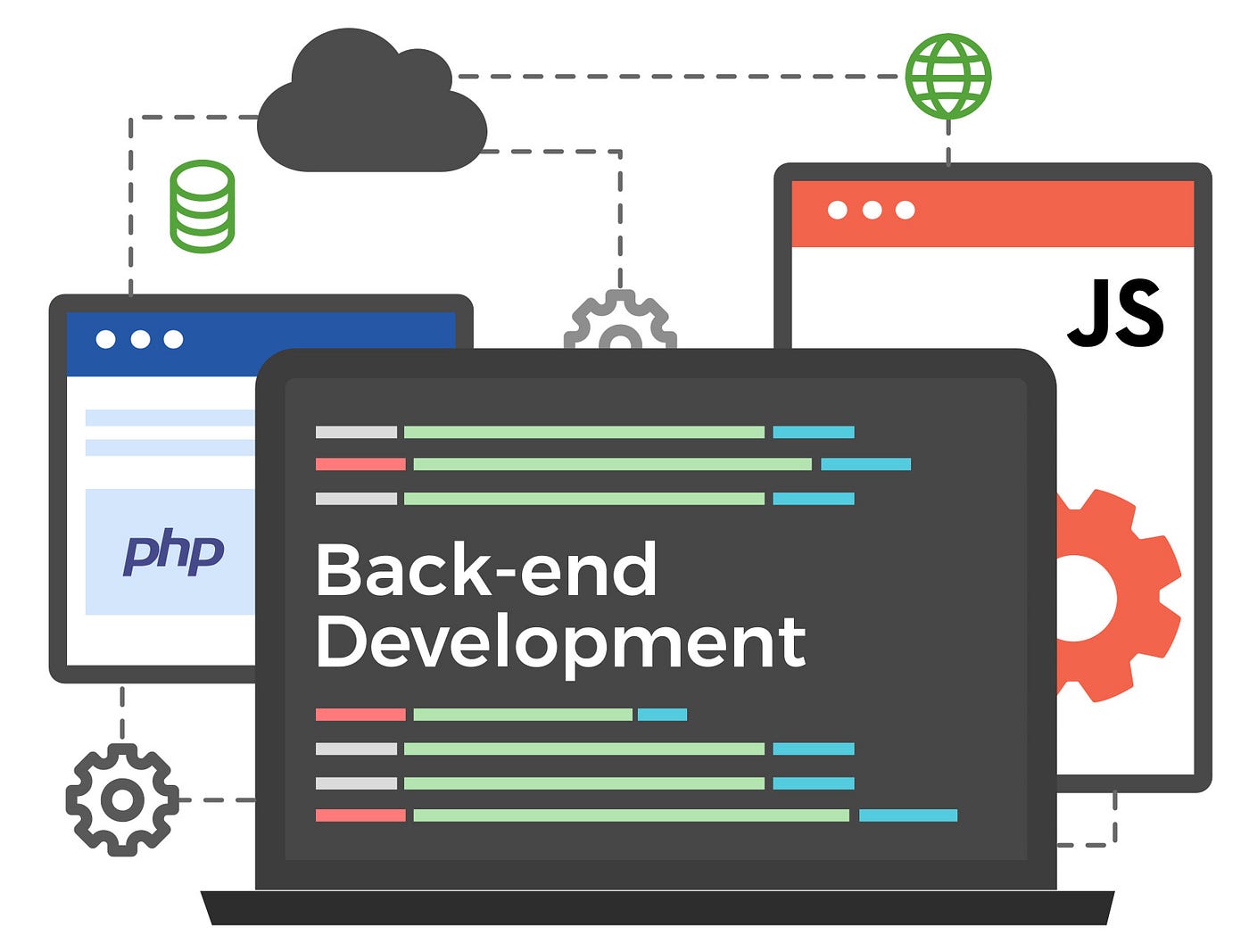
Backend development
Backend development is the engine under the hood of a website or application. While frontend development focuses on everything a user sees and interacts with directly (the "client side"), backend development manages the logic, databases, security, and servers that power the application from behind the scenes (the "server side").
Here is an abstract breakdown of backend development, designed specifically for a beginner.
1. The Core Architecture: Request-Response Cycle
At its heart, backend development revolves around a simple conversation called the Request-Response Cycle.
The Request: You open a web browser, type in a website URL, and hit enter. Your browser sends a "request" over the internet asking for data.
The Processing: A remote computer (the backend server) receives this request. It runs code to figure out who you are, what data you are asking for, and fetches that information.
The Response: The server packages that data up and sends it back to your browser as a "response" (usually HTML, CSS, and JavaScript) to be displayed on your screen.
2. The Three Pillars of the Backend
The backend is generally split into three interconnected components:
The Server
This is a physical or virtual computer connected to the internet 24/7. It listens for incoming user requests and hands them off to your backend application code. Common web server software includes Apache and Nginx.
The Application (The Logic)
This is the actual code written by backend developers. It acts as the brain of the website, handling behind-the-scenes decision-making. This layer handles tasks like:
Authentication: Checking if a password is correct when a user logs in.
Business Logic: Calculating the total cost of an e-commerce shopping cart, including tax and shipping.
Data Processing: Sifting through thousands of products to return only the ones a user searched for.
The Database
Websites need a place to permanently remember things—like user profiles, comments, or product inventories. The database is a highly organized digital filing cabinet. The backend application talks to the database to save new info or retrieve old info using languages like SQL.
3. Common Backend Languages
Unlike the frontend (which relies strictly on HTML, CSS, and JavaScript), you can build a backend using almost any programming language. Popular beginner choices include:
Python: Highly readable and beginner-friendly. Commonly paired with frameworks like Django or Flask.
JavaScript (Node.js): Allows you to use JavaScript on the backend too, meaning you only have to learn one language to build a full website.
PHP: The language that powers WordPress. It is incredibly widespread and built specifically for web development.
Ruby: Focuses on developer happiness and fast development, typically using the Ruby on Rails framework.
4. What is an API?
As a beginner, you will hear the term API (Application Programming Interface) constantly.
Think of an API as a digital waiter. In a restaurant, you (the frontend) don't go into the kitchen (the backend) to cook your food. Instead, you look at a menu, tell the waiter (the API) what you want, the waiter takes your order to the kitchen, and then brings the food back to you.
APIs allow the frontend and backend to talk to each other cleanly, and they also allow different apps to securely share information with one another.